
A low ejection fraction can raise understandable concerns about how well the heart is pumping. Patients may come across treatments such as Enhanced External Counterpulsation (EECP) and wonder whether EECP can improve ejection fraction and overall heart function.
Research has reported improvements in ejection fraction in some groups of patients receiving EECP, but the available evidence does not mean that every patient will experience an increase in EF. Standard heart-failure treatment remains essential, and EECP should be considered only after an individual cardiac evaluation.
At Nuva Healthcare, Indiranagar, Bengaluru, patients can discuss their echocardiogram, ejection fraction, symptoms, medications and previous cardiac reports to understand whether EECP may have an appropriate role in their treatment plan.
Discuss Your Cardiac Reports
Bring your recent echocardiogram, ECG, angiography reports and medication details for an individual EECP evaluation.
Nuva Healthcare – Indiranagar, Bengaluru
Call / WhatsApp:
+91 98864 82146
What Is Ejection Fraction?
Ejection fraction, or EF, describes the percentage of blood pumped out of the heart’s left ventricle each time it contracts. The left ventricle is the heart’s main pumping chamber.
For example, an EF of 60% means that approximately 60% of the blood inside the left ventricle is pumped out during each contraction.
Ejection fraction is useful when assessing heart function, but it should not be interpreted alone. Symptoms, heart structure, valve function, coronary artery disease, rhythm, previous heart attacks, blood pressure and other health conditions also need to be considered.
What Does a Low Ejection Fraction Mean?
A reduced ejection fraction can mean that the heart’s main pumping chamber is not contracting as efficiently as expected.
Low EF may be associated with conditions such as:
- Coronary artery disease
- Previous heart attack
- Cardiomyopathy
- Heart failure
- Some valve conditions
- Long-standing high blood pressure
- Other disorders affecting the heart muscle
Some people with reduced EF may experience breathlessness, fatigue, reduced exercise tolerance, swelling or other symptoms. Others may have relatively few symptoms.
This is why an EF value should always be interpreted together with the patient’s complete cardiac evaluation.
How Is Ejection Fraction Measured?
An echocardiogram is one of the most commonly used tests for measuring ejection fraction. Other cardiac investigations may also be used when clinically necessary.
A doctor may review:
- Ejection fraction
- Heart chamber size
- Heart muscle movement
- Valve function
- Previous heart attack
- Coronary artery disease
- ECG findings
- Symptoms and exercise tolerance
Treatment decisions should therefore not be based on a single EF number.
What Is EECP?
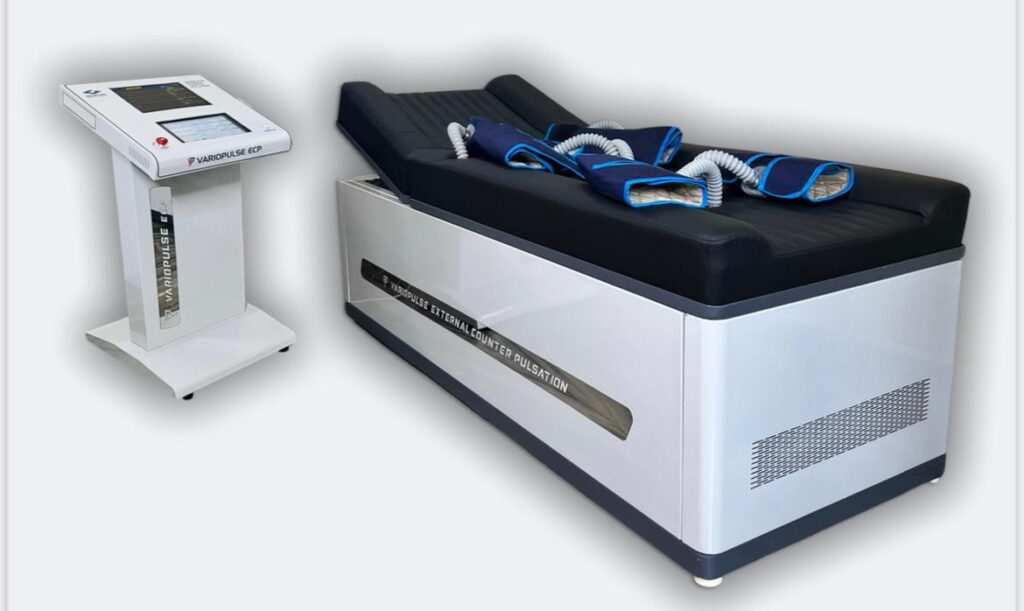
Enhanced External Counterpulsation (EECP) is a non-invasive therapy in which pneumatic cuffs are placed around the lower body.
These cuffs inflate and deflate in coordination with the patient’s heartbeat. The treatment is designed to support circulation during specific phases of the cardiac cycle.
EECP has primarily been studied in selected patients with chronic coronary artery disease and persistent or refractory angina.
For a complete overview, read our EECP Treatment in Bangalore guide.
Can EECP Improve Ejection Fraction?
This is an important question for patients searching for information about EECP ejection fraction improvement.
Some clinical studies have reported improvements in left ventricular function, including changes in ejection fraction, in selected patients receiving EECP.
However, results vary between studies and between patients. The available evidence is not strong enough to promise that EECP will increase ejection fraction for every person with reduced EF.
What this means for patients
EECP should not be described as a guaranteed way to increase EF or normalize heart function.
A more realistic goal may be to evaluate whether EECP could potentially support:
- Exercise tolerance
- Angina symptom management
- Functional capacity
- Circulatory support in selected patients
- Quality of life
Whether any improvement occurs depends on the patient’s underlying cardiac condition, treatment history, general health and individual response.
EECP Does Not Replace Standard Heart-Failure Treatment
Patients with a reduced ejection fraction should continue appropriate heart-failure and cardiology treatment as advised by their treating physician.
Depending on the condition, established treatment may include:
- Guideline-directed medications
- Blood pressure management
- Cholesterol and diabetes management
- Cardiac rehabilitation
- Lifestyle modification
- Implantable cardiac devices when indicated
- Angioplasty when medically required
- Bypass surgery when medically required
EECP should be considered as an additional treatment option for selected patients rather than a replacement for medically necessary cardiac care.
You can also internally link this section to your EECP and Heart Failure article once that page is published.
Who May Enquire About EECP and Low EF?
A patient may consider discussing EECP with a cardiac-care professional when there is an established cardiac condition and a need to explore additional non-invasive options.
This may include selected patients with:
- Coronary artery disease
- Persistent angina symptoms
- Reduced exercise capacity
- Previous angioplasty or bypass surgery
- Persistent symptoms despite medical management
- Reduced EF requiring further evaluation
Having a low ejection fraction alone does not automatically mean that EECP is suitable.
How EECP Suitability Is Evaluated
At Nuva Healthcare, the assessment should focus on the patient’s complete cardiac condition rather than only the EF percentage.
Reports patients may be asked to bring
- Recent echocardiogram
- ECG
- Angiography report
- CT coronary angiography if available
- Previous angioplasty details
- Previous bypass surgery details
- Hospital discharge summaries
- Current medication list
- Recent blood investigations
Symptoms may also be reviewed
- Chest discomfort
- Breathlessness
- Reduced walking capacity
- Fatigue
- Exercise intolerance
- Swelling
- Dizziness or palpitations
This information helps the clinician decide whether EECP should be considered and whether additional cardiac evaluation is needed first.
Why the Same EF Number Can Mean Different Things
Two patients can have the same ejection fraction but very different medical situations.
For example, a patient with a stable EF of 35%, chronic coronary artery disease and persistent angina may require a different treatment strategy from another patient with the same EF who has acute fluid overload, severe valve disease or unstable heart rhythm.
The EF percentage therefore provides useful information, but it is not enough by itself to decide whether EECP is appropriate.
What Happens During EECP Treatment?
During an EECP session, the patient rests on a treatment bed while pneumatic cuffs are positioned around the legs.
The system monitors the heartbeat and synchronizes cuff inflation and deflation with the cardiac cycle.
EECP is:
- Non-invasive
- Performed without surgical incision
- Performed without inserting a catheter into the heart
- Typically delivered as outpatient sessions
- Medically supervised
The number and schedule of sessions should be determined based on the patient’s evaluation and treatment plan.
Potential Benefits and Realistic Expectations
EECP may be considered with the aim of supporting symptoms and functional capacity in selected patients.
Potential areas assessed may include:
- Angina frequency
- Exercise tolerance
- Walking capacity
- Quality of life
- Functional status
- Cardiac-function measurements in selected patients
Some studies have reported improvements in EF, but such improvement cannot be guaranteed.
EECP should not be marketed as a treatment that removes coronary plaque, permanently clears artery blockages, guarantees EF improvement or cures heart failure.
Safety Considerations Before EECP
Although EECP is non-invasive, proper screening is important because the treatment may not be appropriate for every patient.
Conditions that may require special assessment include:
- Unstable or decompensated heart failure
- Significant aortic valve disease
- Uncontrolled severe hypertension
- Certain abnormal heart rhythms
- Deep-vein thrombosis
- Significant peripheral vascular disease
- Other conditions affecting safe cuff compression
A clinician should review these issues before treatment begins.
EECP and Ejection Fraction in Bangalore
Patients searching online for EECP ejection fraction, low EF treatment options, EF improvement or EECP heart function may come across claims suggesting that ejection fraction can always be increased without surgery.
Such claims should be approached carefully.
A more useful medical evaluation asks:
- What is causing the reduced EF?
- Is the patient’s condition currently stable?
- Is coronary artery disease present?
- Is persistent angina present?
- Are current heart medications optimized?
- Is significant valve disease present?
- Are there rhythm problems?
- What is the realistic treatment goal?
These questions help determine whether EECP deserves consideration as part of an overall cardiac-care plan.
Discuss Your Cardiac Reports
If you have been told that your ejection fraction is low, bring your recent echocardiogram and cardiac reports for an individual evaluation.
At Nuva Healthcare, Indiranagar, Bengaluru, our team can review your reports, symptoms and previous treatment history and discuss whether EECP may be appropriate for further consideration.
Nuva Healthcare
Indiranagar, Bengaluru
Call / WhatsApp:
+91 98864 82146
Discuss Your Cardiac Reports on WhatsApp
Treatment suitability and outcomes vary. EECP does not replace emergency cardiac treatment, prescribed medicines, angioplasty, bypass surgery or other treatment when medically indicated.
Frequently Asked Questions
Can EECP increase ejection fraction?
Some studies have reported improvement in ejection fraction in selected patients receiving EECP. However, outcomes vary and an increase in EF cannot be guaranteed. Evaluation of the underlying cardiac condition is necessary before treatment.
Is EECP recommended for everyone with low EF?
No. A low EF alone does not determine whether EECP is suitable. The clinician also needs to review symptoms, heart-failure stability, valve function, blood pressure, heart rhythm, coronary artery disease and other health conditions.
What is considered a low ejection fraction?
Ejection fraction below the normal range may indicate reduced pumping function. The clinical significance depends on the EF value, symptoms, underlying condition and additional cardiac findings. A cardiologist should interpret the result in context.
Can EECP replace heart-failure medicines?
No. Prescribed heart-failure medicines and other standard cardiac treatments remain important. EECP, when appropriate, should be considered as an additional treatment option rather than a replacement for guideline-directed medical care.
Can EECP prevent bypass surgery or angioplasty?
EECP should not be considered a guaranteed way to avoid angioplasty or bypass surgery. Revascularization may still be necessary when medically indicated. Treatment decisions should be based on individual cardiac evaluation.
How is ejection fraction checked before EECP?
Ejection fraction is commonly measured through an echocardiogram. Doctors may also review ECG, angiography, other cardiac imaging, current medicines, symptoms and previous procedures before considering EECP.
Is EECP safe for patients with heart failure?
EECP has been studied in selected stable patients, but it is not appropriate for everyone. People with unstable heart failure, significant valve disease, certain arrhythmias, uncontrolled hypertension or some vascular conditions may require a different approach.
Where can I discuss EECP and low EF in Bangalore?
Patients can bring their recent echocardiogram and other cardiac reports to Nuva Healthcare, Indiranagar, Bengaluru for an individual evaluation and discussion about whether EECP may be appropriate for consideration.