Living with recurring chest discomfort, reduced walking capacity or fatigue despite ongoing heart treatment can affect your confidence and everyday routine. For some carefully selected patients with chronic coronary disease and persistent angina symptoms, Enhanced External Counterpulsation, commonly known as EECP, may be considered as part of a symptom-management plan.
Nuva Healthcare provides consultation and treatment information for people looking for EECP treatment in Bangalore. The first step is not to begin treatment immediately. It is to review your symptoms, medical history, current medicines and previous cardiac investigations to understand whether EECP is appropriate for your condition.
EECP is a non-invasive outpatient procedure. It does not involve an incision, catheter insertion or anaesthesia. However, it is not suitable for every heart patient and does not replace emergency care, prescribed medicines, angioplasty, bypass surgery or regular cardiology follow-up.
Current clinical guidance indicates that EECP may be considered for symptom relief in selected patients with chronic coronary disease, refractory angina and limited remaining treatment options. The supporting evidence is not strong enough to treat EECP as a guaranteed or universal solution, making proper patient selection essential.
Important: New, severe or worsening chest pain—particularly when accompanied by breathlessness, sweating, nausea, faintness or discomfort in the arm, shoulder, neck, back or jaw—requires immediate emergency medical attention. EECP consultation is not a substitute for emergency evaluation.
What Is EECP Treatment?
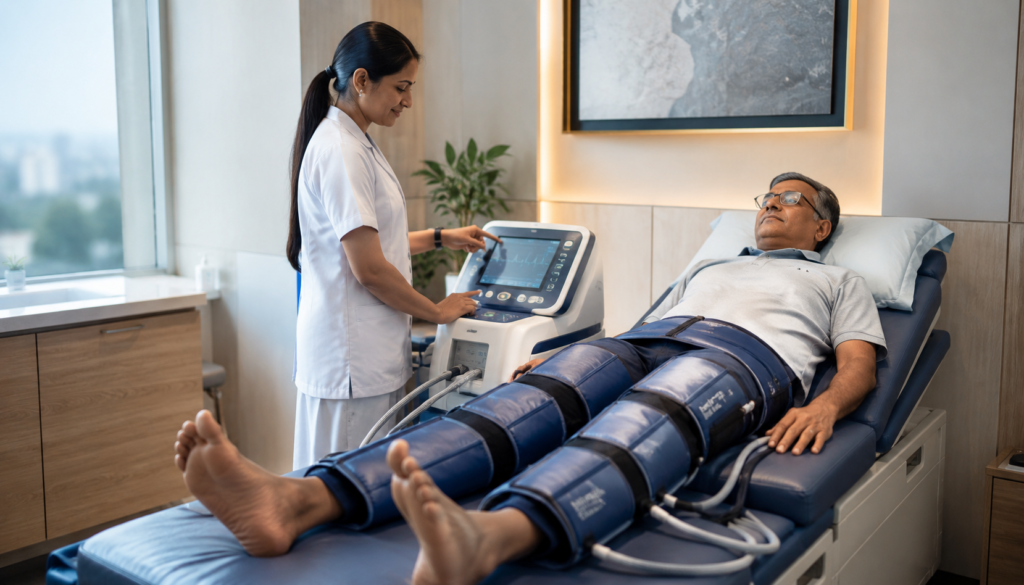
EECP stands for Enhanced External Counterpulsation. During treatment, inflatable cuffs are placed around the lower legs and thighs. The inflation and deflation of these cuffs are coordinated with the patient’s heartbeat using ECG monitoring.
The cuffs generally inflate sequentially when the heart is relaxing between beats and release pressure before the next contraction. This process is designed to influence circulation and reduce the workload against which the heart pumps. The exact treatment pressure and timing are adjusted and monitored according to the patient’s response.
EECP is usually provided as an outpatient service, meaning the patient can normally return home after each session. It is commonly discussed for patients with persistent stable angina whose symptoms continue despite appropriate medical management and who may not have a suitable option for additional coronary intervention.
Is EECP a Non-Surgical Heart Treatment?
EECP is described as a non-invasive or non-surgical treatment because it is performed externally using pneumatic cuffs. There are no surgical cuts, no catheter placement and no general anaesthesia during a standard session.
However, people searching for a non-surgical heart treatment in Bangalore should understand that “non-surgical” does not mean appropriate for every condition. Different cardiac problems require different approaches. Some patients may require medicines, angioplasty, bypass surgery, valve treatment, emergency care or another form of medical management instead of EECP.
EECP should therefore be considered only after a clinical evaluation. It should never be used to delay a recommended emergency procedure or medically necessary intervention.
Who Should Enquire About EECP Treatment in Bangalore?
An EECP consultation may be relevant for people who:
- Have been diagnosed with coronary artery disease or chronic stable angina.
- Continue to experience exertional chest pressure or discomfort despite taking prescribed medicines.
- Experience symptoms that limit walking, climbing stairs or performing routine activities.
- Have previously undergone angioplasty or bypass surgery but continue to have stable symptoms.
- Have been informed that another invasive procedure may not be suitable or may offer limited benefit.
- Want to understand whether an evaluation-based non-invasive option may form part of their symptom-management plan.
- Have previous cardiac reports that can be reviewed before deciding on treatment.
Having one of these concerns does not automatically mean that you are eligible for EECP. Suitability depends on the nature and stability of your symptoms, blood pressure, heart rhythm, valve function, circulation in the legs, heart-pumping function and other medical factors.
The 2023 AHA/ACC chronic coronary disease guideline states that EECP may be considered for symptom relief in patients with refractory angina and no other treatment options. It is not presented as a first-line treatment for every person with chest pain or coronary disease.
What Happens During an EECP Consultation?
Before recommending EECP therapy in Bangalore, the clinical team may review:
- Your present symptoms and when they occur.
- The duration and severity of chest discomfort.
- Your ability to walk, climb stairs and perform daily activities.
- Your current heart medicines and other medications.
- Previous angioplasty, stent placement or bypass surgery.
- ECG, echocardiogram and exercise-test reports.
- Angiogram, CT coronary angiography or cardiac imaging reports.
- History of heart attack, heart failure, valve disease or rhythm problems.
- Blood-pressure control.
- History of leg-vein clots, vascular disease, bleeding problems or anticoagulant use.
Patients should bring available medical records and a complete list of medicines to the consultation. Additional investigations or clearance may be advised when the existing information is insufficient to make a safe decision.
The purpose of this assessment is to answer three practical questions:
- Are the symptoms stable and suitable for outpatient evaluation?
- Is EECP medically appropriate and reasonably safe for this patient?
- What outcome is realistically being considered—such as symptom management, improved activity tolerance or better day-to-day functioning?
What to Expect During an EECP Session
During a typical session:
- You lie comfortably on a padded treatment bed.
- Special cuffs are wrapped around the calves and thighs.
- ECG electrodes are used to monitor the heartbeat.
- A finger sensor or similar monitoring device may be attached.
- The machine synchronises cuff inflation and deflation with the cardiac cycle.
- Treatment pressure is adjusted according to comfort, circulation and clinical response.
- Staff monitor the session and ask about pain, breathing difficulty or other discomfort.
A commonly used EECP course consists of approximately 35 one-hour sessions, often provided five days per week over about seven weeks. The actual schedule may vary depending on the treating clinician’s plan, the equipment protocol, patient tolerance and the number of completed sessions.
Most patients remain awake throughout the procedure. The pressure around the legs can feel strong, especially during the first few sessions. Patients should immediately report chest discomfort, dizziness, unusual breathlessness, leg pain, numbness or skin irritation.
What Are the Potential Benefits of EECP?
In appropriately selected patients, EECP may be considered with the goal of:
- Reducing the frequency or severity of stable angina symptoms.
- Supporting improved tolerance for walking or daily activity.
- Reducing functional limitations caused by persistent symptoms.
- Improving certain aspects of quality of life.
- Providing a non-invasive symptom-management option when conventional choices are limited.
Some clinical studies and patient registries have reported improvements in angina class, exercise tolerance and quality-of-life measures. However, systematic reviews have also highlighted limitations in the available evidence, including small trials, observational data and uncertainty regarding long-term outcomes. Results should therefore be discussed as possible benefits—not guaranteed outcomes.
EECP should not be promoted as a treatment that removes all arterial blockages, permanently cures coronary artery disease, prevents every future cardiac event or guarantees that surgery will never be needed.
Important Considerations Before Starting EECP
Results vary between patients
Some patients may notice meaningful improvement, while others may experience limited or no improvement. The response can depend on the underlying diagnosis, symptom severity, overall cardiac condition, treatment completion and other health factors.
EECP does not replace prescribed medication
Do not stop blood thinners, blood-pressure medicines, cholesterol medicines, anti-anginal drugs or any other prescribed treatment unless the responsible doctor specifically advises a change.
Completing the course requires commitment
A standard course may involve frequent visits over several weeks. Patients should consider travel, work timings and their ability to attend consistently before starting.
Temporary discomfort can occur
Reported treatment-related effects include leg or back discomfort, skin irritation, bruising, abrasions, swelling, tingling and pressure-related discomfort. Padding, clothing adjustments and pressure modifications may help in some cases, but every new symptom should be reported to the treatment team.
EECP is not an emergency treatment
Sudden or worsening chest pain must be evaluated urgently. Do not travel to a routine EECP appointment while experiencing symptoms that may represent a heart attack or another acute cardiac condition.
Who May Not Be Suitable for EECP?
EECP may be unsuitable, postponed or require specialist clearance in patients with certain medical conditions. Examples can include:
- Unstable or rapidly worsening angina.
- Acute or decompensated heart failure.
- Severely uncontrolled blood pressure.
- Significant aortic valve regurgitation or certain other valve conditions.
- Deep-vein thrombosis or active thrombophlebitis.
- Severe peripheral arterial disease affecting the legs.
- Aortic aneurysm or dissection.
- Recent arterial puncture or certain recent cardiac procedures.
- Significant bleeding disorders or anticoagulation-related concerns.
- Heart rhythms that prevent the machine from synchronising correctly.
- Severe leg wounds, infections or skin conditions in cuff-placement areas.
- Pregnancy.
This is not a complete self-screening checklist. Some conditions may be absolute contraindications in one clinical situation but require individual risk assessment in another. Final suitability must be decided after reviewing the patient’s complete medical condition.
EECP Therapy in Bangalore: Why Location and Scheduling Matter
A complete EECP course can involve multiple visits. Choosing a centre that is reasonably accessible can make it easier to attend sessions consistently and arrive without unnecessary physical strain.
Nuva Healthcare offers EECP consultation and treatment information in Indiranagar, Bangalore. Patients from Indiranagar, Domlur, HAL, Ulsoor, Koramangala and other parts of Bengaluru may contact the clinic to check consultation availability, session timings and the medical records required for assessment.
Before travelling, patients or family members should confirm:
- Consultation availability.
- Whether an appointment is required.
- Which cardiac reports to bring.
- Approximate session frequency and timing.
- Whether any medical clearance is needed.
- Whether the patient should be accompanied.
- Treatment charges and payment information.
What Reports Should You Bring?
For a more useful consultation, bring copies of available:
- Recent prescriptions.
- ECG reports.
- Echocardiogram reports.
- TMT or stress-test reports.
- Coronary angiogram or CT coronary angiography reports.
- Angioplasty, stent or bypass-surgery records.
- Hospital discharge summaries.
- Recent blood-test reports.
- Current medication list.
- Blood-pressure records.
- Identification and contact information for a family member.
Do not delay an emergency evaluation while trying to collect reports. These documents are intended for planned outpatient consultations involving stable symptoms.
Frequently Asked Questions About EECP Treatment in Bangalore
1. Is EECP a surgery?
No. EECP is an external, non-invasive procedure performed using inflatable cuffs around the lower limbs. It does not normally involve an incision, catheter or general anaesthesia.
2. Is EECP suitable for every heart patient?
No. EECP is generally considered only for selected patients after reviewing their diagnosis, symptoms, investigations, current treatment and possible contraindications.
3. Can EECP cure coronary artery disease?
EECP should not be described as a guaranteed cure for coronary artery disease. In selected patients, it may be considered to help manage persistent angina symptoms or functional limitations. Individual results vary.
4. How many EECP sessions are usually required?
A commonly used protocol consists of around 35 one-hour sessions, often scheduled five days per week. The exact course must be determined by the treating clinical team.
5. Is EECP painful?
The cuff pressure can feel strong, and some patients may experience temporary leg discomfort, skin irritation or bruising. Treatment pressure and padding may be adjusted based on tolerance. Any significant pain must be reported immediately.
6. Can I stop my heart medicines after beginning EECP?
No. Never stop or alter prescribed heart medicines without instructions from the doctor responsible for your care. EECP is generally considered alongside continued medical management rather than as an automatic replacement for it.
7. Can a patient enquire after angioplasty or bypass surgery?
Yes, a patient with continuing stable symptoms after a previous procedure may enquire. Suitability depends on the reason for the symptoms, the timing of the previous procedure, current investigations and the treating clinician’s assessment.
8. Can patients with heart failure undergo EECP?
Some patients with heart failure may not be suitable, particularly when the condition is unstable or decompensated. Heart failure status and heart-pumping function must be evaluated before treatment. Routine use should not be assumed.
9. What is the cost of EECP treatment in Bangalore?
The total cost can depend on the consultation, number of sessions, treatment protocol and whether additional investigations are required. Contact Nuva Healthcare for current consultation and treatment-charge information.
10. When should I seek emergency care instead of booking an EECP consultation?
Seek emergency medical help for new, severe, prolonged or worsening chest pressure, especially with breathlessness, sweating, nausea, faintness or pain spreading to the arm, shoulder, back, neck or jaw. Do not wait for an outpatient appointment.
Book an EECP Consultation at Nuva Healthcare, Indiranagar
If you or a family member has persistent stable angina symptoms and would like to understand whether EECP treatment in Bangalore may be considered, begin with a consultation and medical-record review.
Nuva Healthcare’s team can explain:
- How EECP treatment works.
- Which medical reports are required.
- Whether further evaluation or clearance may be needed.
- Expected session frequency.
- Important precautions and suitability considerations.
- Consultation availability and estimated treatment cost.
Call or WhatsApp Nuva Healthcare:
+91 98864 82146
Location:
Nuva Healthcare, Indiranagar, Bangalore
Suggested CTA Button:
Book an EECP Consultation
Suggested WhatsApp Button Text:
“Hello Nuva Healthcare, I would like to enquire about EECP treatment in Bangalore. Please share consultation availability and the medical reports I should bring.”
Treatment recommendations are made only after individual evaluation. No particular improvement or outcome can be guaranteed.