If you are researching EECP after bypass surgery Bangalore options because chest discomfort, breathlessness or activity limitation has returned after CABG, the first step should be a fresh cardiac evaluation. Previous bypass surgery does not automatically mean that EECP is appropriate, and recurrent symptoms should not simply be assumed to be the same problem you had before surgery.
At Nuva Healthcare, Indiranagar, Bengaluru, an EECP enquiry after bypass surgery should begin with your current symptoms, previous CABG details, angiography or graft information, heart function, medications and recent cardiac investigations.
For selected patients with chronic, stable and persistent angina who remain symptomatic despite medical treatment and do not have an appropriate further revascularisation option, Enhanced External Counterpulsation may be considered for symptom relief. Evidence is limited, however, and treatment selection requires medical evaluation.
Emergency warning: New, severe, prolonged or rapidly worsening chest pain requires urgent emergency medical care. Chest pain occurring at rest, severe breathlessness, sweating, fainting, nausea or pain spreading to the arm, jaw or back should not wait for an outpatient EECP appointment. EECP must never delay medically indicated angioplasty, repeat bypass surgery or other emergency cardiac treatment.
Why Can Angina Return After Bypass Surgery?
Coronary artery bypass grafting, or CABG, creates new pathways for blood to travel around significantly narrowed coronary arteries. It can provide major symptom relief, but it does not permanently eliminate coronary artery disease.
When symptoms return months or years later, possible explanations can include:
- changes or narrowing within a bypass graft
- progression of disease in the patient’s original coronary arteries
- disease developing in coronary areas that were not previously bypassed
- microvascular or other forms of myocardial ischaemia
- heart-valve or heart-function problems
- rhythm abnormalities
- non-cardiac causes of chest discomfort or breathlessness
The timing of symptoms also matters. Chest pain shortly after surgery needs a different approach from predictable exertional symptoms returning several years after CABG.
This is why recurrent symptoms should be assessed before choosing angina after bypass EECP treatment.
Who May Enquire About EECP After Bypass Surgery?
A consultation may be worth considering if you have recovered from previous CABG but continue to experience chronic, stable symptoms despite appropriate medical treatment.
Examples may include patients who:
- have recurrent stable angina after previous bypass surgery
- develop predictable chest pressure during walking or exertion
- have reduced activity because of stable cardiac symptoms
- remain symptomatic despite prescribed anti-anginal treatment
- have undergone assessment and been told another revascularisation procedure is not currently suitable
- have complex coronary disease requiring discussion of additional symptom-management options
Previous CABG alone is not an indication for EECP. The important questions are whether the current symptoms are genuinely caused by myocardial ischaemia and whether further medical or revascularisation options have already been appropriately considered.
EECP Post CABG Bangalore: What Should Be Checked First?
Patients with recurrent symptoms after bypass surgery often need more than a description of how EECP works.
The healthcare team first needs to understand what has changed since the operation.
Depending on your situation, assessment may involve reviewing:
- your original CABG operative details
- which coronary arteries were bypassed
- type and location of bypass grafts
- current pattern of chest discomfort
- ECG
- echocardiogram
- stress-test or myocardial-ischaemia information
- coronary angiography or CT coronary angiography where available
- previous stent procedures
- heart function
- current cardiovascular medicines
Further testing is not automatically required for everyone. The cardiology team should decide what is appropriate based on the symptoms, previous investigations and time since surgery.
How Does EECP Work?
EECP stands for Enhanced External Counterpulsation.
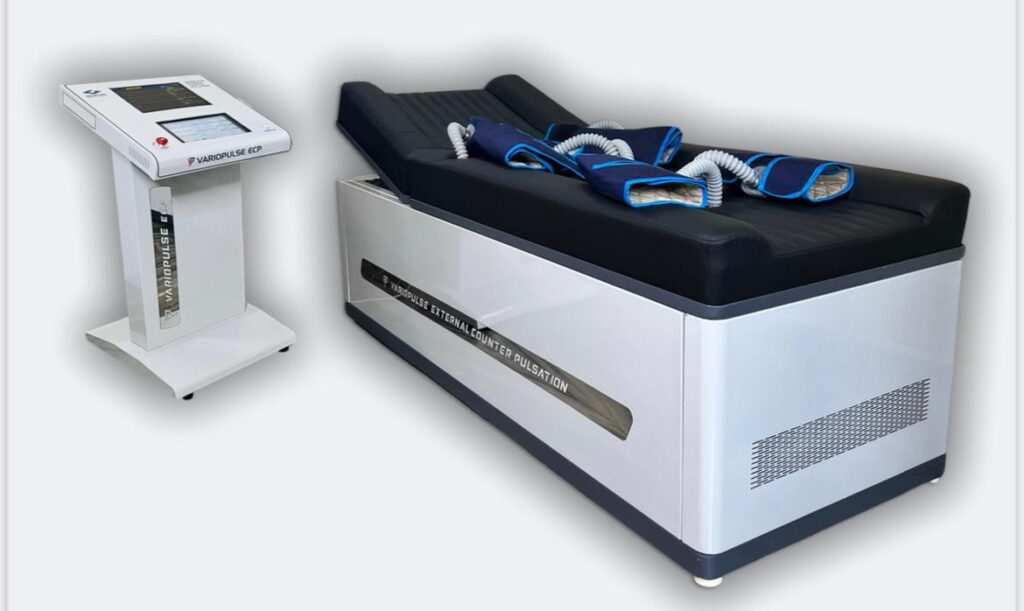
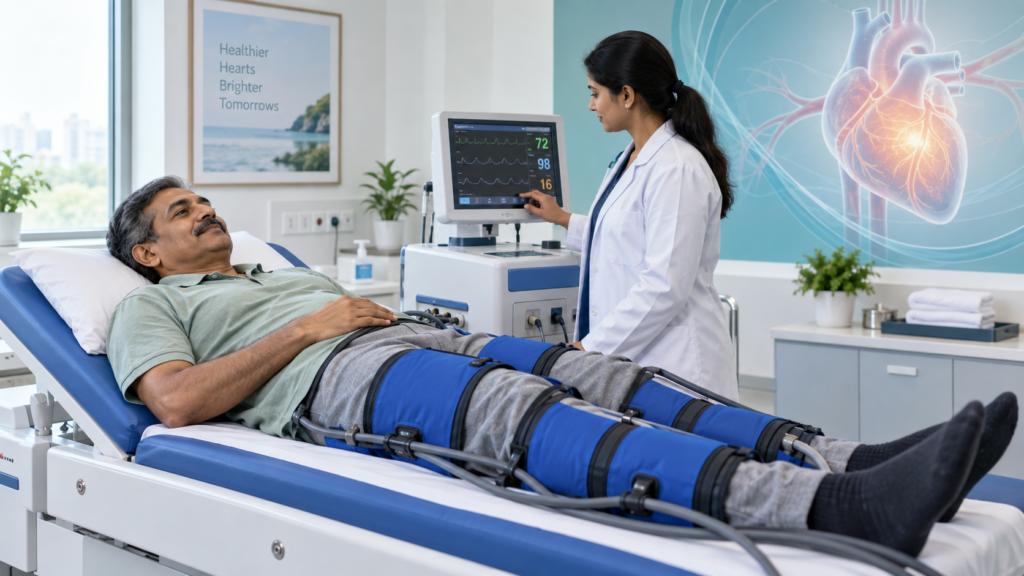
It is a non-invasive outpatient treatment. During a session, inflatable cuffs are placed around the lower limbs while the patient lies on a treatment table.
The machine monitors the heartbeat and coordinates cuff inflation and deflation with the cardiac cycle.
The cuffs inflate during the resting phase of the heartbeat and then release rapidly before the next heart contraction. This creates externally applied pressure intended to influence circulation and cardiac workload.
There is no surgical incision, catheter placement or new coronary stent involved in the EECP session itself.
EECP also does not physically remove plaque from the coronary arteries or bypass grafts.
Does EECP Reopen a Blocked Bypass Graft?
No.
EECP should not be marketed as a treatment that mechanically opens, cleans or removes blockage from an old bypass graft.
If investigation identifies important graft narrowing, native coronary disease or another anatomical problem, cardiologists need to determine whether medical therapy, PCI, repeat surgical assessment or another approach is appropriate.
EECP has a different role. In carefully selected patients with persistent chronic angina and limited remaining treatment options, it may be considered as a non-invasive symptom-management approach.
Can EECP Replace Another Angioplasty or Bypass?
Not automatically.
A patient who has already undergone CABG may understandably prefer to avoid another invasive procedure. That preference is important, but it does not determine what treatment is medically appropriate.
If recurrent symptoms are caused by coronary disease that is suitable for revascularisation and a cardiology team believes angioplasty or repeat surgical treatment is indicated, EECP should not be used to postpone necessary treatment.
Current cardiovascular guidance places EECP mainly in the setting of refractory angina where symptoms continue despite medical therapy and other treatment options are not available or suitable.
What Happens at the EECP Consultation?
The consultation should establish whether your symptoms are stable, whether sufficient cardiac evaluation has already been completed and whether there are reasons EECP may be unsuitable.
You may be asked about:
- when the bypass operation was performed
- when symptoms returned
- whether symptoms occur with activity or at rest
- how far you can comfortably walk
- breathlessness, fatigue or reduced exercise tolerance
- previous heart attacks
- angioplasty or stents after CABG
- heart-rhythm problems
- heart-valve disease
- leg circulation or venous problems
- blood-pressure control
- current medications
If bypass surgery was recent, appropriate postoperative recovery and clearance are particularly important before considering a repeated external-pressure treatment.
What Happens During an EECP Session?
Once a patient has been considered suitable, cuffs are positioned around the legs and connected to the EECP system.
ECG monitoring allows the equipment to time the pressure cycles with the heartbeat. During treatment, you feel the cuffs repeatedly tighten and release.
The patient remains awake throughout the session.
EECP is commonly delivered as a course of repeated outpatient sessions rather than as a single treatment. The exact schedule should follow the treatment centre’s medical protocol and individual patient assessment.
Progress should be evaluated during the course rather than assuming that every patient will respond in the same way.
What Benefits May Be Possible After CABG?
For appropriately selected patients with persistent chronic angina, the intended goals of EECP may include:
- reducing the burden of stable angina symptoms
- making ordinary physical activity more comfortable
- improving exercise tolerance for some patients
- reducing symptom-related limitations in daily life
- supporting quality of life where refractory angina remains troublesome
These are potential outcomes, not promises.
The evidence base for EECP remains limited compared with standard anti-anginal medicines and established revascularisation procedures. Current guidelines therefore use cautious wording such as “may be considered” for selected patients with refractory angina and no other treatment options.
Previous bypass surgery does not guarantee that EECP will improve symptoms.
Who Should Not Self-Select EECP?
An online advertisement is not enough to determine whether EECP is safe or appropriate.
Additional caution or another treatment approach may be needed in patients with conditions such as:
- unstable or rapidly worsening angina
- a recent acute cardiac event
- recent cardiac surgery without appropriate recovery and clearance
- significant aortic valve regurgitation or other relevant valve disease
- rhythm abnormalities that interfere with treatment synchronisation
- uncontrolled high blood pressure
- active blood clots or significant venous disease
- severe peripheral arterial disease
- active bleeding or important bleeding disorders
- certain unstable heart-failure conditions
- pregnancy
This is not a complete contraindication list. Medical evaluation is required because suitability depends on the patient’s current condition and the treatment equipment being used.
Possible Side Effects During EECP
Because EECP applies repeated pressure around the lower body, some patients may experience:
- skin irritation
- bruising
- temporary muscle soreness
- leg discomfort
- numbness or tingling
- fatigue
- swelling
Any new chest discomfort, marked breathlessness, severe leg pain, unexpected swelling or other concerning symptoms should be reported promptly.
EECP After Bypass Surgery Cost in Bangalore
Patients comparing EECP after bypass surgery Bangalore providers often want to know the total treatment cost before committing to repeated sessions.
There is no medically responsible single price that can be given to every patient without understanding the treatment plan.
Cost may depend on:
- initial cardiac consultation
- review of previous CABG and angiography reports
- whether new investigations are required
- recommended EECP schedule
- monitoring requirements
- number of sessions
- follow-up assessment
Before purchasing a treatment package, ask:
- Has my suitability been medically assessed?
- What is included in the quotation?
- Are cardiac investigations separate?
- What treatment schedule is recommended and why?
- How will my response be reviewed?
- Is post-treatment assessment included?
Nuva Healthcare can discuss an estimated cost after reviewing the patient’s actual requirements instead of relying on an outdated generic online price.
What Reports Should You Bring After CABG?
Post-bypass patients should bring as much relevant previous cardiac information as reasonably available.
Useful records may include:
- CABG discharge summary
- bypass surgery operative report if available
- previous coronary angiography reports
- angiography images or CD
- graft or coronary anatomy information
- ECG
- echocardiogram
- stress-test or nuclear perfusion reports
- CT coronary angiography if previously performed
- records of angioplasty or stenting after CABG
- recent blood-test results
- current medication list
- recent cardiology consultation notes
Do not delay the consultation because one report is unavailable. Bring what you have and ask whether additional evaluation is needed.
Should Heart Medicines Continue During EECP?
Yes, unless your treating doctor specifically changes them.
Starting EECP is not a reason to stop antiplatelet medicines, cholesterol-lowering therapy, blood-pressure treatment, anti-anginal medicines, diabetes treatment or other prescribed cardiac medicines.
Long-term secondary prevention remains important after bypass surgery because CABG does not eliminate the underlying tendency toward coronary artery disease.
EECP After Bypass Surgery in Indiranagar, Bengaluru
Because EECP involves repeated outpatient visits, location can be a practical consideration for post-CABG patients.
Nuva Healthcare is located in Indiranagar, Bengaluru, making consultation accessible for patients travelling from areas such as:
- Indiranagar
- Domlur
- HAL
- Old Airport Road
- Jeevan Bhima Nagar
- Ulsoor
- MG Road
- Koramangala
- nearby Bengaluru neighbourhoods
When comparing centres, consider the quality of cardiac screening and monitoring alongside convenience and price.
How to Compare EECP Centres After CABG
Before starting treatment, ask:
- Will my previous bypass and angiography reports be reviewed?
- Has the cause of my recurrent symptoms been investigated?
- Who determines whether another angioplasty or surgery should be considered?
- How is EECP monitored?
- What contraindications are checked?
- What happens if my chest pain changes during treatment?
- How will progress be reviewed?
- What is included in the total estimated cost?
A responsible treatment centre should be willing to advise against EECP when another cardiac evaluation or treatment pathway is more appropriate.
When Chest Pain After Bypass Surgery Is an Emergency
Do not assume that chest discomfort after previous bypass surgery is simply chronic angina.
Seek urgent emergency medical care for:
- new or severe chest pain
- chest pain that is becoming more frequent or intense
- pain occurring at rest
- persistent chest pressure
- severe breathlessness
- cold sweating
- fainting or severe weakness
- pain spreading to the arm, jaw, shoulder or back
EECP is an outpatient treatment and is not emergency therapy for acute coronary syndrome or a heart attack.
If cardiology assessment identifies a need for urgent angioplasty, repeat bypass evaluation or another cardiac intervention, EECP must not delay that treatment.
Considering EECP After Bypass Surgery in Bangalore?
If you are researching EECP after bypass surgery Bangalore because stable angina or activity-related symptoms have returned after CABG, start with your previous cardiac records and a current medical assessment.
Recurrent angina can have several causes, including bypass-graft problems and progression of coronary disease. The cause needs to be understood before deciding where EECP may fit.
For selected patients with chronic refractory angina who remain symptomatic despite appropriate medical treatment and have limited further revascularisation options, EECP may be considered for symptom relief. It should not be presented as a method that removes coronary blockage or as a guaranteed replacement for angioplasty or bypass surgery.
Speak with our heart-care team about report review, treatment suitability, appointment availability and estimated cost. Call/WhatsApp +91 98864 82146.
Can I have EECP after bypass surgery?
EECP may be considered for selected patients who continue to have chronic stable angina after previous CABG, particularly when symptoms persist despite medical treatment and further revascularisation is not considered appropriate. Medical evaluation is required before starting treatment.
Why can chest pain return after bypass surgery?
Recurrent symptoms can have several causes, including changes in bypass grafts, progression of disease in the original coronary arteries, other cardiac conditions or non-cardiac causes. The reason for recurrent chest discomfort should be evaluated before choosing treatment.
Does EECP reopen a blocked bypass graft?
No. EECP does not mechanically remove plaque or reopen an obstructed bypass graft. If important graft or coronary narrowing is present, a cardiology team should determine whether medical treatment, angioplasty, surgical assessment or another approach is appropriate.
Can EECP replace another angioplasty or bypass operation?
Not automatically. EECP may be considered for selected patients with refractory stable angina, but it is not a guaranteed replacement for angioplasty or repeat bypass surgery. If revascularisation is medically indicated, EECP must not delay it.
How does EECP work after CABG?
The EECP procedure is performed in the same general way as in other eligible patients. Inflatable cuffs around the legs are synchronised with the heartbeat to apply and release pressure during specific phases of the cardiac cycle. Previous CABG does not change the need for individual suitability assessment.
How many EECP sessions are needed after bypass surgery?
EECP is normally provided as a course of repeated outpatient sessions. The appropriate schedule should follow the centre’s clinical protocol and the patient’s individual assessment rather than assuming every post-CABG patient needs exactly the same course.
What reports should I bring for an EECP consultation after CABG?
Bring available CABG discharge and operative records, coronary angiography reports or images, ECG, echocardiogram, stress-test results, subsequent angioplasty or stent records, recent investigations and your current medication list.
Is EECP safe for every patient who has undergone bypass surgery?
No. Current symptoms, time since surgery, heart rhythm, valve function, blood pressure, vascular health and other medical conditions need to be considered. Recent cardiac surgery or unstable symptoms require appropriate cardiology assessment rather than self-selecting EECP.
What is the cost of EECP after bypass surgery in Bangalore?
Cost can vary according to consultation, required investigations, treatment schedule, number of sessions, monitoring and follow-up. Nuva Healthcare can discuss an estimated cost after reviewing your cardiac history and treatment requirements.
When is chest pain after bypass surgery an emergency?
New, severe, prolonged or worsening chest pain, pain occurring at rest, severe breathlessness, sweating, fainting or pain spreading to the arm, jaw or back requires urgent emergency medical care. Do not wait for an EECP appointment, and do not allow outpatient EECP to delay indicated angioplasty, bypass evaluation or other emergency cardiac treatment.